

SPHERE Showcases Research, Education, and User Impact at MERIF 2026
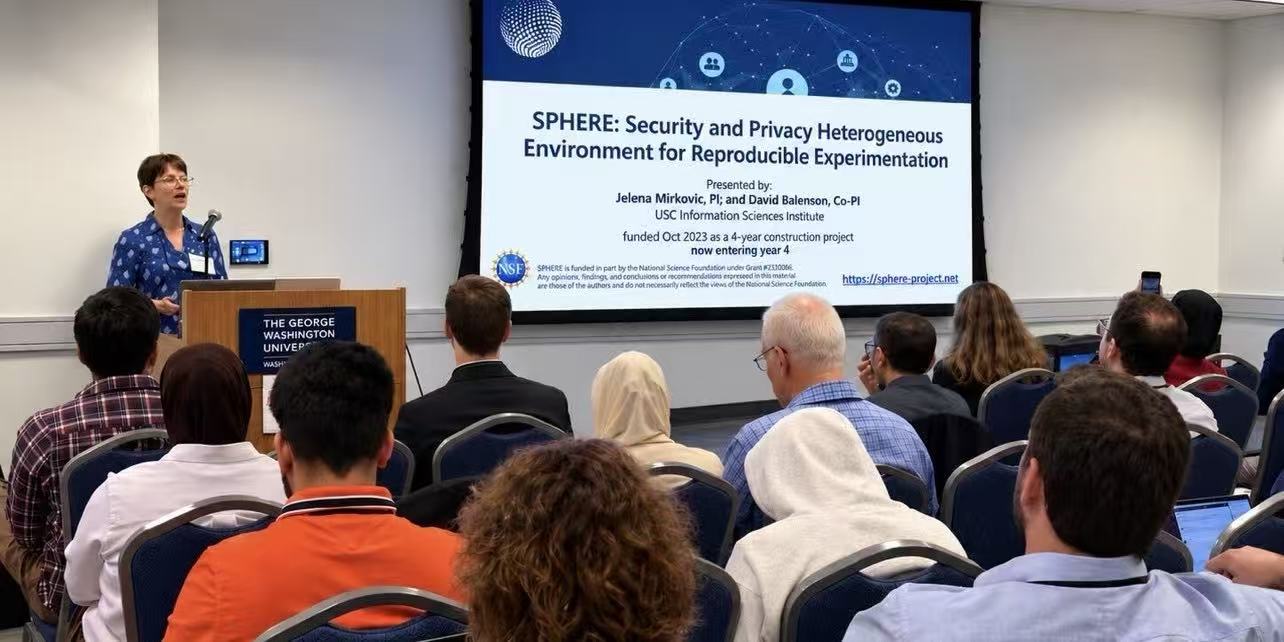
SPHERE participated in the 2026 Midscale Experimental Research Infrastructure Forum (MERIF), held September 29–30 at The George Washington University in Washington, D.C. Members of the SPHERE team and user community contributed throughout the two-day workshop through presentations, demonstrations, session leadership, and program planning.
This year’s theme, “Elevating User Impact,” brought together NSF-supported research infrastructure providers and users to share best practices, reduce barriers to access, and strengthen cross-facility, reproducible research. SPHERE’s participation reflected each of these goals, highlighting lessons from building the infrastructure as well as the growing range of research and education that SPHERE now enables.
Building SPHERE and Looking Ahead
SPHERE Principal Investigator Jelena Mirkovic presented an update on SPHERE, its unique capabilities, and its growing beta user community, while sharing lessons learned from building a midscale research infrastructure for security and privacy experimentation.
She highlighted the importance of engaging users early and involving students through internships, as well as practical challenges encountered during SPHERE’s development, including longer-than-expected timelines for hardware procurement and facilities work.
Looking ahead, she discussed opportunities for greater collaboration among midscale research infrastructures. These include making it easier for researchers to access multiple facilities and enabling experiments to move more readily between different platforms, goals that closely align with MERIF’s emphasis on cross-facility research and reducing barriers to infrastructure use.
SPHERE in Action: Research and Education
A central part of SPHERE’s participation at MERIF was showcasing how researchers and educators are already using the infrastructure. Presentations and demonstrations spanned automotive cybersecurity, distributed AI systems, cybersecurity education, and portable cyber experimentation.
Chandrima (Dimpy) Ghatak of Colorado State University presented SPHERE-CAN, which connects a physical automotive network testbed at Colorado State University to the SPHERE research infrastructure, and also demonstrated the system during MERIF’s Demo and Poster Night. The demonstration showed how researchers can remotely configure and run experiments on real automotive networks, including monitoring live network traffic, injecting messages, executing attacks, and recording the resulting system behavior. By making physical automotive systems remotely accessible through SPHERE, SPHERE-CAN supports reproducible experimentation and evaluation of automotive cybersecurity.
Yizhuo Liang, a Ph.D. student in Computer Science at USC, presented StreamEP, a new approach designed to improve large-scale LLM inference on academic GPU clusters where network bandwidth may be non-uniform or affected by other workloads. The research was evaluated using SPHERE’s GPU cluster at USC ISI, taking advantage of specialized capabilities including its dual RoCE network fabric to study distributed LLM workloads under conditions that can be difficult to reproduce in mainstream public clouds.
Peter Peterson, professor at the University of Minnesota Duluth and a member of the SPHERE Advisory Board, presented work demonstrating how SPHERE can support hands-on cybersecurity education. His presentation highlighted capabilities such as step-by-step exercises, automated grading, and hints that can help instructors provide practical cybersecurity learning experiences while reducing the effort required to manage complex experimental environments.
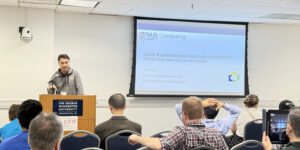
SPHERE researchers Anis Bin Yusof and Zhenkai Liang from National University of Singapore (NUS) presented CRADLE, a high-level language for Cyber Experimentation as Code. CRADLE separates the intent of an experiment from testbed-specific implementation details, allowing a high-level experiment description to be translated into deployment material for different supported platforms. Their presentation used both a compact CVE example and a larger multi-stage scenario to illustrate how this approach can make experiments easier to describe, reproduce, and potentially move across different research infrastructures.
Together, these presentations showed the breadth of activities that SPHERE can support, from experiments involving specialized physical hardware and large-scale distributed systems to reproducible cyber experimentation and hands-on education.
USC-ISI Keynote and Workshop Leadership
The broader USC Information Sciences Institute community also played an active role at MERIF 2026.
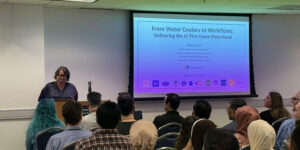
ISI Fellow Yolanda Gil delivered the keynote presentation, “From Watercoolers to Workflows: Delivering the AI That Users Most Need.” Her talk explored how AI-enabled research infrastructure can be designed around researchers’ real needs and existing workflows, including ways AI can lower barriers to interdisciplinary research.
SPHERE Project Manager Alba Regalado served on the MERIF Advisory Board, helping guide the workshop’s overall theme and organization. USC-ISI Managing Director Terry Benzel served on the Program Committee, contributing to the development of the workshop program. Jelena Mirkovic and Terry Benzel also chaired sessions during the workshop.
These contributions extended SPHERE’s involvement beyond presenting its own work, giving members of the SPHERE and USC-ISI communities an opportunity to help shape broader discussions about the future of research infrastructure.