

Homepage




SPHERE RESEARCH INFRASTRUCTURE
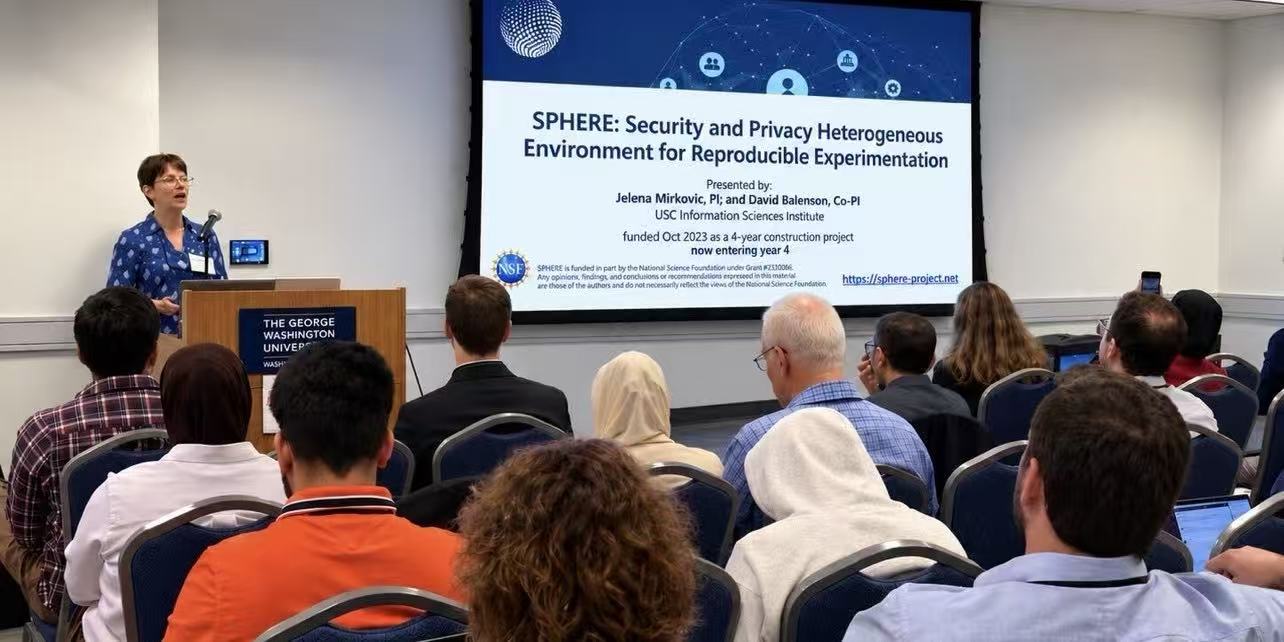
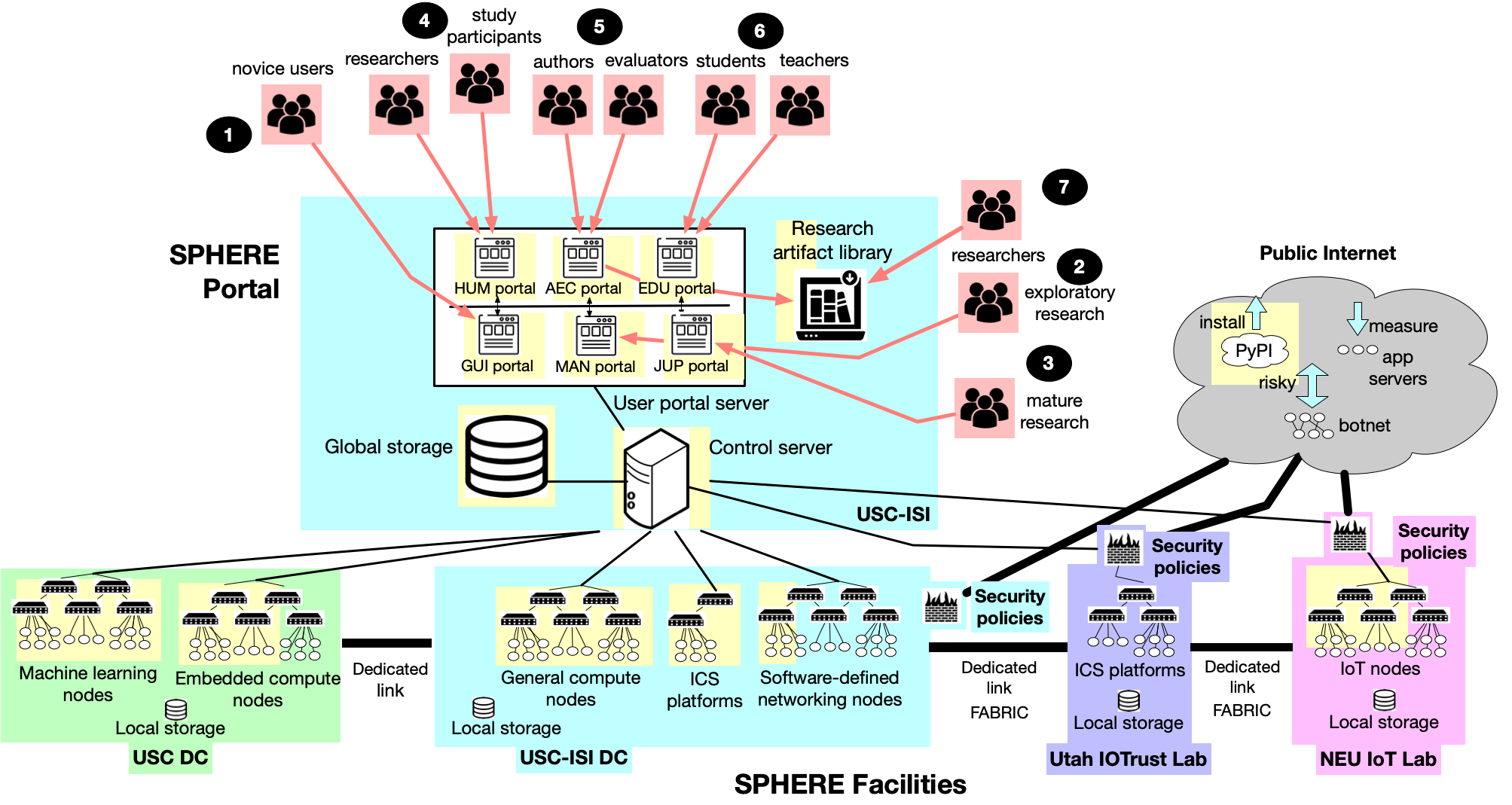
SPHERE (Security and Privacy Heterogeneous Environment for Reproducible Experimentation) is a public research testbed funded by the NSF and constructed by the USC Information Sciences Institute, Northeastern University Khoury College of Computer Sciences, and the University of Utah Kahlert School of Computing. It supports integrated, reproducible cybersecurity and privacy research through access to diverse, user-configurable hardware, software, and networking resources via six specialized user portals. It aims to transform cybersecurity and privacy research, enabling representative, sophisticated, and reproducible experimentation that allows researchers to build on the work of their peers, thus supercharging scientific progress. In addition to scientific experimentation, SPHERE enables a broad range of activities including education, workforce training, cybersecurity exercises, and rigorous test and evaluation.






GETTING STARTED WITH SPHERE
While the SPHERE infrastructure is still undergoing construction, it is open to beta users using currently available resources. To begin using SPHERE, click the “Register” button in the top-right corner of the homepage to create an account; returning users can log in via the adjacent “Login” button. Once approved, you can begin designing and running experiments using SPHERE’s intuitive interfaces and configurable infrastructure. The platform also provides user guides, tutorials, and community support to help you make the most of its capabilities.
Researchers, educators, students, and industry partners can collaborate with SPHERE by contributing experiment artifacts, participating in community workshops, or integrating SPHERE into academic courses, training programs, or cybersecurity exercises.
HOW SHOULD I CITE SPHERE?
If you use SPHERE in your research and publish results based on that work, we would appreciate a citation to SPHERE. At present, the best reference is:
Jelena Mirkovic, David Balenson, Brian Kocoloski. Enabling Reproducibility through the SPHERE Research Infrastructure. USENIX ;login: Online, USENIX Association, December 16, 2024. https://www.usenix.org/publications/loginonline/enabling-reproducibility-through-sphere-research-infrastructure
title={Enabling reproducibility through the {SPHERE} research infrastructure},
author={Mirkovic, J and Kocoloski, B and Balenson, D},
booktitle={Usenix ;login Magazine},
year={2024}
}
CALL FOR REPRESENTATIVE EXPERIMENT ENVIRONMENTS (REEs)
Reproducibility is essential to scientific progress, yet it remains a persistent challenge in computer science, particularly in systems, networking, and cybersecurity and privacy research. SPHERE addresses this challenge by supporting reusable, transparent research artifacts that make it easier for others to build on prior work. To advance this goal, the SPHERE research infrastructure solicits Representative Experimentation Environments (REEs) for integration into SPHERE.
Selected REE contributors receive paid virtual internships to port their environments to SPHERE, increasing accessibility and long-term impact. Submissions are accepted on a rolling basis throughout the year, and applicants may indicate their preferred start term (spring, summer, or fall). To be considered for a summer internship, submissions must be received by April 15.
PLEASE TAKE OUR COMMUNITY NEEDS SURVEY
We are running a survey to learn about researcher needs around cybersecurity and privacy experimentation. Your input will inform our future endeavors in supporting cybersecurity experimentation through our recently funded SPHERE research infrastructure. We want to hear from a wide range of researchers, no experience is too small. The form has six open-ended questions, it is anonymous and you can skip any questions.
SPHERE USER FEEDBACK SURVEY
We invite you to take the SPHERE User Feedback Survey. This short survey is intended for researchers, students, and collaborators who have used SPHERE resources and/or interacted with the SPHERE team. Your feedback will help us improve SPHERE services, infrastructure, and user experience.